The task seemed simple enough. We’d volunteered to hoist the sail. Two crew members ushered us towards the front of the boat where ropes were tethered to the mast. Each colour-coded rope controlled a different kind of sail, the prevailing wind determining which was required. Easy enough, I assumed, and gripped the rope that was handed to me, then braced for action, waiting for my cue. There’s a technique to hoisting the sail, I learnt, pulling with all my might for the entire length of my body so I could get my full weight behind each downward thrust.
At first the sail glided smoothly upwards like a hot knife through butter. But then, a few full-body heaves in, it began fighting me. With only a few inches to go, the rope refused to budge. I felt the entire crew’s eyes on me, collective breaths held as I winced and strained, utterly defeated.
What they knew but I did not was that the final bit of hoisting required the ‘coffee grinders’, a set of manually-operated winches that do in fact look like gigantic coffee grinders and are operated by two pairs of arms. Trimming the sail, I realised, is a team effort, more about working in sync than possessing arm strength.
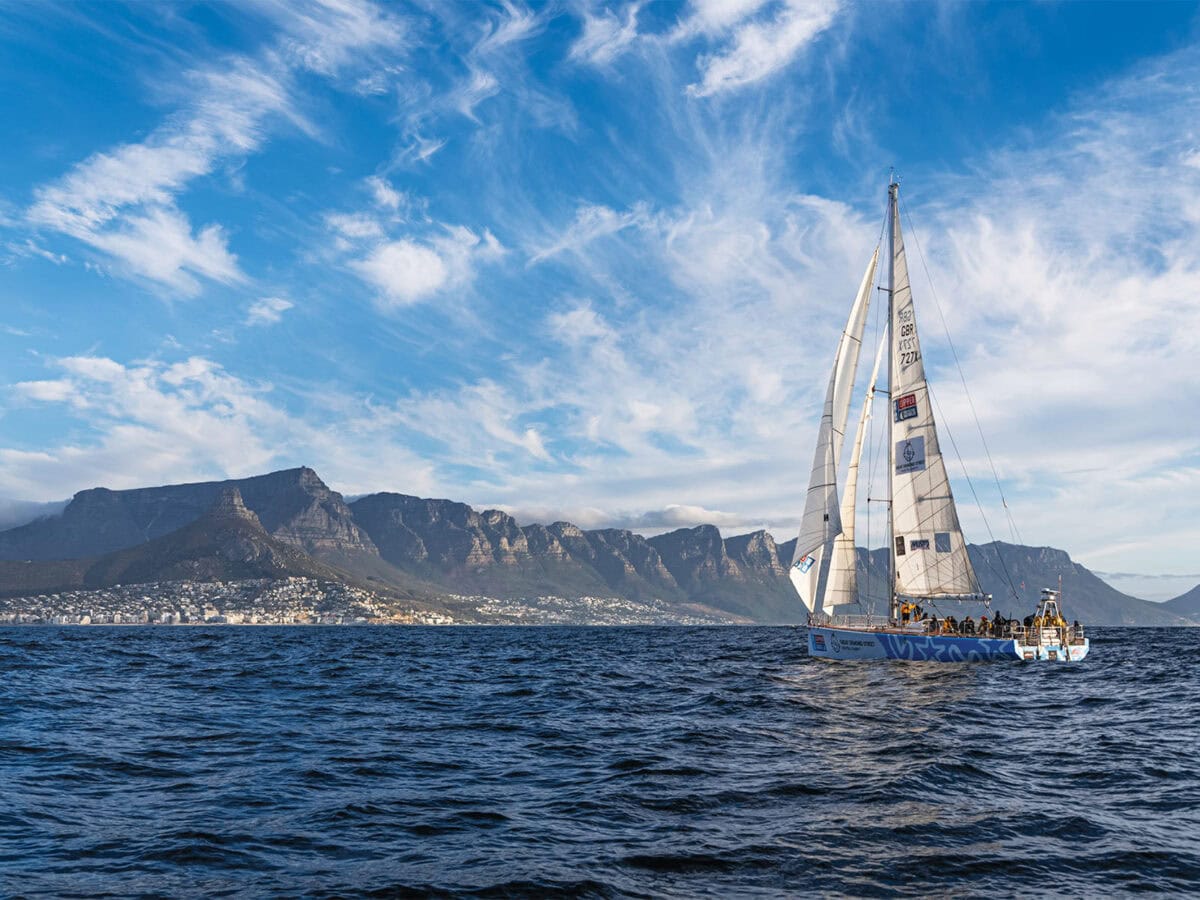
Later, after a few hours of smooth sailing around Table Bay, learning to stow ropes and work the grinders for a bit, I got a turn at the tiller, skippering the boat back towards the harbour.
Ahead, the city and mountains grew steadily larger as a light wind whipped my face, the sense of control over this sleek, state-of-the-art vessel was about the most glorious sensation on earth. Get it right, and sailing makes you feel like you can achieve just about anything.
Not that I’d been expecting to hoist a sail, let alone steer. That morning, we’d boarded one of the yachts participating in the Clipper Round the World yacht race for just a tiny taste of what competitors in one of humanity’s great maritime adventures get to experience for weeks on end.

Remarkably, many of the crew we met that morning had themselves first learned to sail only a few months before. Even though most participants have more experience behind them, around 40 percent have little or none before they sign up. They can opt to take part in single or multiple legs of the race with those signed up to complete the full circumnavigation scheduled to arrive in Portsmouth in the UK in July 2026 having set sail in August 2025.
More than 7 000 people and three generations of Clipper fleets have competed in what is considered the toughest ocean racing challenge available to novice sailors. In this, the 14th edition, there are 10 boats competing, each with up to 22 crew members. According to Dylan Kotze, a South African who is one of the professional skippers taking part, the yachts are designed for extreme ocean-racing conditions, but are stripped of all luxuries, built to be rugged and reliable, with minimal reliance on complex systems. In other words, it offers a taste of old-school sailing, albeit aboard a sleek, formidable vessel.
It’s no luxury tournament and there are few creature comforts. No first-class berths, no smart amenities, no quiet sanctuaries to escape to.
‘Watch your head,’ Kotze warns as he takes us below deck. ‘There are quite a few things to bump heads on.’ As we explore the tight quarters, what strikes me most is the absolute absence of private space. Much of the below-deck area is for the storage of the sails, ultimately the most important resource after the humans themselves.
‘This is the galley,’ Kotze says, pointing out the narrow, cramped cooking area. A couple of metres away is the navigation system. Nearby bunks shared by crew members are squished together among the dry pantry goods that have been bought for the next leg, a 28-day crossing of around 5 000 nautical miles from the V&A Waterfront to Fremantle, Australia.
‘We’ve got two watches: one team sails while the other sleeps,’ Kotze explains. ‘They share bunks, so when teams swap over they just turn the mattress around. It gets quite tight in there.’
It could only look inviting through the lens of exhaustion, the inevitable result of perpetual physical exertion and challenge, which is precisely what these crew members have signed up for.

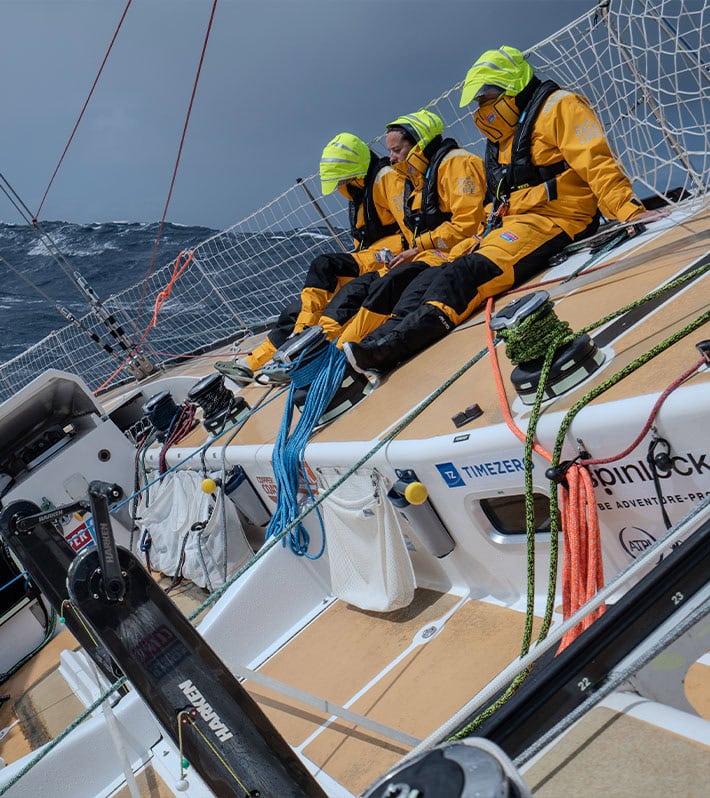
By the time they arrived in Cape Town in November, the crews had already seen some serious action, departing Portsmouth in August, stopping in Spain, and crossing the equator all the way down to Uruguay before heading back across the Atlantic to Cape Town. ‘We’ve done more than 10 000 nautical miles of sailing already,’ Kotze says, pointing out the route on the electronic screen.
There had been the rough weather in the Bay of Biscay where they’d been hit by powerful winds for hours, and crossing the doldrums was another anticipated challenge. Such wild times are precisely why people choose to participate: a chance to meet the unknown and find out what they’re capable of. It’s not only the rookies who relish the experience. Kotze, who has been sailing his entire life, called it the opportunity of a lifetime. ‘To sail around the world is something I’ve been looking forward to my whole life – it’s definitely a big challenge for me. And to do it with the Clipper Race is mind-blowing.’
There’s a look of exhilaration and awe when you ask crew members about the rough seas and hectic waves, a sense of surviving something unimaginable. Everyone spoke about the incredible marine wildlife – pilot whales and dolphins and large schools of mahi-mahi swimming alongside the boat. And there was the thrill of witnessing a huge electrical storm as they approached South America. ‘Like gigantic strobe lights across the night sky,’ says Kotze.
While the leg from Cape Town to Fremantle means navigating the less-than-ideal conditions – enormous swells and extreme cold – of the Roaring Forties, even more challenging is the later Pacific crossing from Tongyeong City in South Korea to Seattle, Washington. During this difficult section of the race, crews face huge depressions that roll across every few days, causing hurricane-level winds and waves of more than 20 metres – extreme sailing unlike anywhere else on earth. It’s hostile and arduous, but also beautiful and one hell of an adventure, which is what participants are seeking.
Once accepted, participants complete an intensive fourweek training programme to learn everything from safety and navigation to advanced racing tactics and survival at sea.
The race, which spans 40 000 nautical miles, has taken place, on average, every two years for three decades. It’s the brainchild of Sir Robin Knox-Johnston, a maritime adventurer who was the first person to sail solo non-stop around the world. He did so in 312 days, completing his circumnavigation in April 1969. He was awarded a CBE in recognition, but says the reason he did it was because ‘I didn’t want to look at myself in the shaving mirror at age 90 wishing I’d done it’.

Applicants require drive, fortitude and enthusiastic spirit, and perhaps a bit of naïve self-belief. There’s nothing cushy about the experience, and participants quickly discover that neither the weather nor the waves stop because someone’s having a bad day.
‘The fact is that if something goes wrong you can’t change the channel,’ says Knox-Johnston. ‘You’ve got to get up and deal with it. It’s very much a hands-on thing – seamanship is learned through your hands, not through books. Sailing a boat isn’t just sitting back in a cockpit or steering, it’s knowing everything about the boat, keeping the boat going, keeping it maintained. It’s highly practical and that’s what the four-week training is all about – we try and turn out all-round sailors at the end of it, with safety a priority.’
Kotze says the training is extremely thorough. ‘Lots of manoverboard drills, learning to get the sails up and down, tacking, jibing, and being able to do all the manoeuvres on the boat.’
All the boats are the same, nothing to distinguish one from the next. ‘They’re all identical 70-foot boats and it’s really up to the crew to make them go as fast as they can,’ says Kotze. ‘That’s where the race lies.’
Kotze says the competitive aspect ultimately comes down to skill with the sails. ‘It’s the sail set up that you use and how long you can push certain sails in different wind conditions. Navigation is obviously very important as it determines what weather, wind and currents we experience, but fine-tuning and trimming the sails and helming are crucial determinants of speed.’


He says the smallest differences add up to make the hugest impact over such a long period and it’s been very close racing at times. ‘We do thousands of miles and sometimes there’s just 10 minutes separating two boats at the finish, so it can really be quite exciting.’
‘My greatest satisfaction is looking at them when they come back,’ says Knox-Johnston. ‘Someone who is 18 at the start has the headspace of a 24-year-old at the finish. They’ve matured so much. Even a CEO aged 60 comes back standing taller. They’ve done something with their lives. They don’t have to boast about it, but within themselves they know they’ve done something special.’
As much as it’s an experience of physical participation and rising to an unimaginable challenge, Kotze says the race also provides a unique set of conditions for something far deeper. ‘It’s a relentless environment in which everyone relies intensely on one another,’ he says. ‘Once you realise that you can’t do this alone, you discover something incredibly profound about what it is to be human.’