
‘I assume they all think I’m a lunatic,’ says Cape Town chef Ryan Cole. ‘A bit off the wall is how most people probably think of me.’
Whatever ‘most people’ think, Cole, whose first restaurant, Salsify, opened six years ago, is on a quest to change perceptions of what South African dining is – and what an elevated African meal can be.
At his new venture, Coy, he’s asked his chefs (those folks most likely to have first-hand accounts of his lunatic tendencies) to dig deep into their personal food memories and search for authentic expressions of Africa’s diverse culinary heritage.

The restaurant occupies a seemingly implausible location, a veritable no-man’s-land between docks at the V&A Waterfront where harbour authorities can at any moment remove one of the pedestrian bridges, making it potentially confusing to reach. Cole worries that diners will literally get lost, but the potential adventure in that simply adds to the allure of finding a restaurant that epitomises the notion of hiding in plain sight.
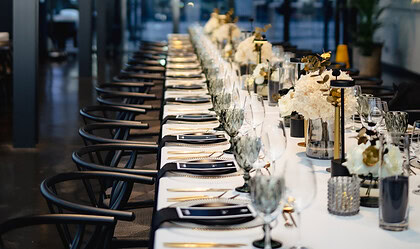
When you do arrive, the rewards are many. Enfolded by city, mountain and harbour views, it’s an astonishing ebony-hued space. Instead of the light, white-tablecloth formula associated with most fine-dining places, it’s dark, moody and full of texture.
Within this space, Cole is committed to showcasing African culinary flair in previously unimagined ways. ‘We’re putting Africa onto a pedestal – not looking towards France or elsewhere in the world.’
While Cole says it’s ‘incredible that so many Cape Town chefs are hitting great heights, knocking on the door of the World’s Top 50 Restaurants’, he believes there’s a paucity of high-end places where African cuisine is part of the conversation. At Coy he wants to ‘shine a spotlight on the continent’ and ‘explore
our narrative’.
Everything you eat here is inspired by Cole’s intension to make Coy ‘different’ from the rest. That means bravely swimming against the mainstream, ignoring trends and boldly turning away from Eurocentric fine dining in favour of a more soulful, personal and unapologetically nostalgic culinary experience.


He’s eager, too, to embrace the diversity of South African identities. ‘We’re a melting-pot nation, all very different. My mother’s Scottish and my father’s grandfather came from Ireland, but I’m as South African as the next South African.’
This identity mash-up, he says, defines who we are as a nation and creates maximal opportunity for discovery in the kitchen. Joining him on this mission are Teenola Govender and Geoffrey Abrahams, joined-at-the-hip head chefs who, like Cole, have something new to say about African cooking.
‘Teenola is Indian and I’m coloured,’ says Abrahams. ‘We each grew up with very different interpretations of what South African food is, but here we want to touch on the variety that exists as part of our melting-pot heritage, so it’s not just braaivleis or potjie. We’re looking across the board at how food connects all
of us as Africans.’
Their menus are concise, flavour-focused homages to Africa’s diversity, each dish inspired by a personal story or memory.
Some of the elements are so familiar, so homegrown and unexpected, they’re borderline alarming. Like that oh-so-yellow seasoning Aromat (made in-house at Coy), which is used to bring a distinctive umami-ness to a beautiful vegetarian main course of mielie samp and chakalaka, something that’s quintessentially South African and intimately connected to the food memories of diverse people in contrasting contexts.
This cheeky combination hits your tastebuds and drags you back in time while simultaneously letting your brain know that you’re experiencing newness: it’s nostalgia that feels like rocket science.
Abrahams calls it ‘craveability’. ‘That’s the big thing we wanted to achieve with our food. You don’t return to a restaurant because the concept is clever; you come back because you crave more of the food. We want every single dish to be something you can’t wait to come back and try again. You must wake up the day after dining here and think about returning for a dish that really hit the spot with its deliciousness.’
‘We’re not reinventing the wheel, or changing the world,’ says Govender. ‘We simply want to present something different because our fine-dining scene is so saturated. And so very Eurocentric.’

That said, there are ample moments when what goes into your mouth at Coy does in fact suggest that the world has shifted off its axis slightly, that your understanding of what food can be has been altered.
One such dish is Govender’s tuna tartare, a cold starter for which she referenced her childhood in Durban. ‘I wanted to showcase sugar cane, because of my memories of having fresh sugar-cane juice at the beachfront. So we’ve incorporated sugar cane, tamarind and coconut into this tuna dish as a way of showcasing flavours from my hometown.’
Cole calls the dish ‘inspired’. ‘It’s solid, clever, delicious. It’s a dish you absolutely want to eat again. It ticks all the boxes, and it’s something that – when I taste it – reminds me why I cook.’
That assessment of Govender’s seafood starter also neatly expresses why Cole is so loved by his peers. To young chefs, he’s not a lunatic, he’s an inspiration, someone willing to champion their creative impulses.
‘Some people cook for CVs, some cook for awards, but I cook because I love it,’ he says. ‘I’m 35 now, have worked in the kitchen since I was 15 and I just love cooking. I love prepping. I love all the physical aspects, like service and putting dishes together and just being, like, “This is so delicious!”’

Someone who shares that passion and is similarly driven to pioneer what he calls ‘modernised African cuisine’ is Wandile Mabaso, a chef who grew up in Soweto. He discovered the power of food as a young boy who, out of necessity, taught himself to cook, and now owns and runs the much-lauded Sandton restaurant, Les Créatifs.
Mabaso says everything he does is sparked by his love of creating a meal. ‘I believe cooking – like music and sport – is something that brings people together, unites different cultures, and can stop wars.’
He says he cooks because he loves using food to touch people’s hearts, connecting with them through the stories from his childhood that his dishes evoke. People who grew up in a township environment and who now come to his high-end restaurant often leave with tears in their eyes. He says it’s because the food sparks powerful memories.
‘I’ve travelled the world, cooked with the best. I don’t need to prove how good I am, or see how many awards I can win. It’s really about reaching within and telling stories about how I grew up, sharing the flavours of my childhood.’
At Les Créatifs, he brings his understanding of both classical and modern French technique to riff dishes that are steeped in tradition and have a deep heritage. One adored beef dish is his Krugersdorp Tongue and Cheek. It represents ‘those very cheap cuts of meat we ate, almost like street food’, he says, ‘but elevated to a high level’. Mabaso uses methods of preparation that are ‘very technical and very French’ so that over many days and multiple cooking processes, he sends out tongue that’s been slow-braised in a rich beef broth and cut with spices to give it an ‘almost nostalgic braai flavour’. Alongside it are lush, very soft, moist beef cheeks that have been braised separately.


And, on the side, there’s amadumbe, a starchy, potato-like indigenous tuber that’s popular among Zulu subsistence farmers. He uses it to make mash infused with puréed achar fermented in his own kitchen. ‘I use my grandmother’s achar recipe,’ he says. ‘As soon as you put that in your mouth, you get an explosion of flavour that reminds you where you are – and where you come from.’
He says that sense of a shared past is a key part of his cooking. ‘If you leave my restaurant without tears in your eyes, I haven’t achieved anything – no matter how good the food is, or how great the service was. If I don’t touch your heart, I feel like nothing’s been achieved. The only way to touch your heart is through emotions. And the only way to get to your emotions is by really taking you back, perhaps to that smile that reminds you of your grandmother when you were five years old.’
Sometimes it takes ‘just a single bite’, he says, ‘to make the memories come flooding back’.
Like Cole and co., Mabaso is intentionally aiming to ‘incorporate more of Africa’ into his cooking.
Keith Bain