
There’s a battle raging in the blissful, bucolic Hemel-en-Aarde Valley. Don’t expect war cries or gunfire, though. It’s not that kind of war. More like a peaceful campaign to bring folks to their senses.
Leading the charge is Carolyn Martin, co-owner of Creation Wines, which she and her Swiss-born husband, winemaker Jean-Claude, established in 2002.
The enemy is what Carolyn describes as a neo-prohibitionist movement that, from certain quarters, has been calling for a blanket ban on alcohol. Carolyn believes the movement is possibly a threat to the ancient art of winemaking.
While Jean-Claude (JC) is letting nature do all the heavy lifting in this battle, Carolyn is determined to show the world that wine can be part of a healthy lifestyle, which is why she has become such a keen standard-bearer for the cause of fine wine.

‘It’s really about context, so enjoying quality wines need not conflict with wellness, nor with longevity,’ says Carolyn, who comes from a multigenerational winemaking family. In 1980, her uncle, Peter Finlayson, set up Bouchard Finlayson, the first winery in the Hemel-en-Aarde Valley. In 2002, it was Peter who showed JC a 40-hectare sheep farm in the faraway Hemel-en-Aarde Ridge and convinced him to buy it.
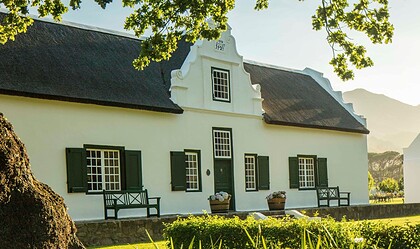
Scenically, the entire Hemel-en-Aarde wine route, which stretches along the R320 between Hermanus and Caledon, is magnificent. Drive through for a tasting and you feel you’ve arrived in proper countryside. Bulging with winemaking awards and some of the country’s best- and least-known wine farms, it’s dominated by family-run operations committed to working with nature rather than aggressively taming it, thus keeping biodiversity strongly intact.


Some say the land itself is magic. The soil comprises 450-million-year-old Bokkeveld shale and drained clay loam. For many winegrowers, it’s the proximity of this fertile ground to the cold Atlantic that creates the real alchemy. A system of circulating breezes acts as natural air-conditioning that ensures precisely the right cool-climate conditions for its Burgundian varietals to grow successfully.
It’s why Hemel-en-Aarde has a reputation for Pinot Noir and Chardonnay. ‘During the growing months, there’s a half-degree difference between temperatures here and in Burgundy,’ Carolyn says. ‘There’s something magical about this terroir for that cultivar.’
JC is besotted with the location. ‘No matter what you do in this business, the grapes will always contribute at least 80 or 90 percent plus to the quality of the end product. So location is everything and if you have the opportunity to start a farm anywhere in the world, you should opt for a place that will provide optimal grapes.’
JC began with absolutely nothing. In 2002, there wasn’t even a feasible road. But it ticked many other boxes. In just over 20 years, the land has gone from difficult-to-access sheep farm, to what the World’s Best Vineyards has crowned the best wine farm in Africa, and fourth best in the world.
JC’s philosophy is centred on allowing nature to express itself through the wine. He worked his first European harvests as a teenager, and made his first wines in a garage – impressive enough to earn him a winemaking position at Domaine Grillette in Neuchâtel. He continues to work the old-fashioned way, pruning and harvesting by hand, keeping machines out of the vineyards. He says it’s a shame to grow beautiful, top-quality grapes but then see them bruised and damaged by machine harvesters.


At the same time, he is also ruthlessly hands-off. If it’s a particularly warm year, he says, that should be expressed in the vintage. He adds nothing that would homogenise or otherwise alter the wine’s character. He uses wild yeast on the ferments, doesn’t use any fining agents and avoids filtering red wines. ‘No enzymes are added, no tannins, absolutely nothing that can be added from the whole catalogue of additives that are now standard in winemaking.’
What he has done, however, is exercise his freedom to plant adventurously. Apart from the two Burgundian cultivars, he’s successfully experimented with other varietals. Since the valley benefits from being warmer for a bit longer than other cool-climate regions, he planted the first Grenache vineyard in the area and was the first to bottle a single-variety Viognier. He also grows Syrah and has created a Bordeaux-style white blend using Sauvignon Blanc and Sémillon.
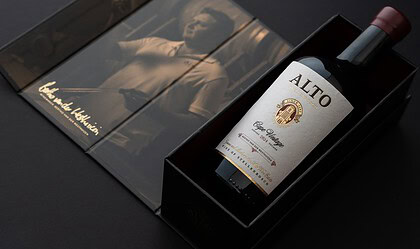
Creation makes about 19 different wines, including a Reserve range produced from grapes in single-site vineyards.
‘We’re super-fortunate because wine fashion has evolved over the last 15-or-so years,’ he says. ‘The trend is for elegant wines, with good acidity, lighter in style, not too much alcohol. And that’s precisely what this place has on offer. We make elegant wines, not too heavy, not too alcoholic. It’s what’s possible in a place with cooler growing conditions.’

The other great advantage is a kind of reprieve from rapidly mounting anxiety over climate change. ‘Right now, in this pocket, we’re seeing far less hectic climate impacts than in many other places. The ocean essentially balances out these climactic ups and downs. As long as the ocean stays reasonably cold, we don’t really get the full exposure of climate change. Which is a really incredible opportunity.’
It’s not just the weather, there’s an element in the tension between the ancientness of the geology and the youthfulness of the creative spirit that has been identified as the ‘special something’ that defines the terroir of the Hemel-en-Aarde.
At the tasting room restaurant, Carolyn has found a way of representing this. When you look out, you see the ancient mountains, and the display of eight different kinds of soil on the farm. These elements are balanced by fresh, groundbreaking wines, a smart menu that taps into innovative ideas about food and wellness, and staff who embody youthful energy.
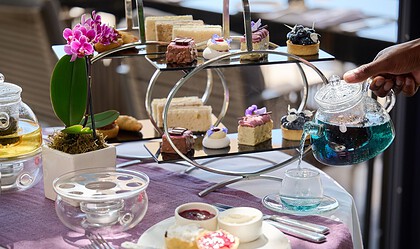
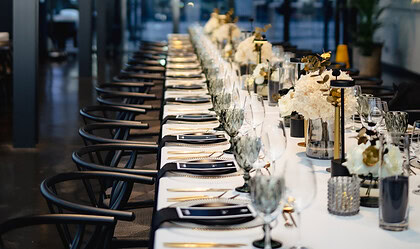
Lunch is a lot more than several courses paired with JC’s elegant wines. Spread across your table there might be shells, chunks of ancient rock, and perhaps a fabric pouch. There are vials of natural fragrances, too, used to demonstrate how the perfume of a wine alters its taste. The entire meal can get quite touchy-feely, a kind of sensory immersion.
Each course is formulated with wellness in mind while hitting the right notes in terms of the wines it accompanies. Your Sauvignon Blanc might be paired with watercress and parsnip soup, with a dash of cumin oil. The idea, Carolyn says, is to warm your body and protect your digestive lining, so it keeps your blood-sugar level low and your energy level high.
Creation’s Viognier, with its delicate freshness and white jasmine on the nose, might be paired with silken agedashi tofu. And there’s an ‘Oh so umami’ course, just before dessert, comprising bone marrow with broth, capers, lemon and small squares of toasted seed loaf. It’s served with Creation’s Syrah Grenache blend – a full, hearty experience.


Unlike so many longwinded tasting menus, there’s nothing overwhelming or exhausting about this one. It’s all about nourishment and fine flavours rather than fanfare. The menus Carolyn and her team have developed are based on Ayurvedic principles – there’s also no gluten, no dairy and practically no sugar. Creation’s head chefs have not only done stints in Michelin-star restaurants in Europe, but have also worked with integrated health experts.
This, too, is part of Carolyn’s campaign to showcase the healing benefits of quality food alongside nature-nurtured wines. As a young girl growing up on wine farms, one of her chores was to cook for the vineyard team. Her grandmother, who taught her about food, insisted that they prepare nourishing meals for all the staff. That was at a time when the notorious dop system was still in full swing in South Africa, and so Carolyn witnessed first-hand the dangers of alcohol abuse and how cheap wine negatively skewed perceptions of humanity’s relationship with viticulture.
Which is why she crusades for the cause of fine wine, something she believes can be part of a healthy lifestyle.
‘We need to secure the future of fine wine, not only in South Africa, but around the world,’ she says. ‘What’s important is how we nurture the land, what we do to look after the environment, how we treat and uplift our people, contribute to the economy in meaningful ways, and inspire hope.
‘There are good reasons why wines have been part of human culture for 8 000 years,’ she says.
And if Carolyn and JC have their way, winemaking will be with us for the next 8 000 at least.
Keith Bain