
Victor Hugo called cognac the ‘liquor of the gods’ but he probably never tasted an aged pot-still brandy from the Cape. While cognac is unlikely to be knocked off its throne as the ultimate symbol of French luxury, it’s notable that South African brandies – racking up armloads of ‘best in the world’ trophies year after year – rarely feature in breathless conversations about what it is the gods of Hugo’s imagination do in fact sip after dinner.
Unless you talk to the experts, that is.
People like KWV brandy master Pieter de Bod whose life’s passion is to create the most harmoniously balanced brandies imaginable.
‘I get goosebumps just talking about it,’ he says of KWV’s 15-year-old brandy. ‘It just explodes in your mouth, a very soft brandy with such complexity. And full of surprises, each flavour giving way to another – beautiful tawny port, vanilla, sweet tobacco, and then apricot and dry fruit. Then, you smell it again and you taste crème brûlée, chocolatey Christmas pudding, caramel, nuts. But the best part for me is the elegant, long, lingering flavour.

It stays in your mouth for such a long, long time. I think it’s gorgeous.’ But it’s like picking a favourite child, De Bod says, each one is loved for different reasons. He says his KWV 20-year-old has its own unique genius.
‘Normally, if you smell an older brandy, you get old flavours: cigar box, a lot of wood. But when you first smell our 20-year-old, it’s very fruity, almost tricking you into assuming it’s not all that old. When you taste it, an explosion happens, all those wonderful fruit-cake, spice, old-oak and honey flavours, which you don’t anticipate from the aroma profile.’
He says that this surprise element is possibly why it garners so many awards.
De Bod is a proud parent to these fine expressions of Cape spirit distillation. ‘I assume we’ve done a good job to have earned the title “best brandy producer” six times in the last eight years, all of the “best brandy” trophies, and “best brandy in the world” seven times in the last nine years.’
He says, too, that some of his favourite feedback comes straight from the mouths of French experts, his colleagues in Cognac. On at least one voting panel – that of London’s International Spirits Challenge – representatives from three of France’s biggest cognac producers, Hennessy, Rémy Martin and Courvoisier, have spoken highly of aged South African brandies to De Bod (the panel’s chairman).
De Bod says it comes down to Cape brandy’s fruitier flavours, a result of our climate. The difference is that our grapes are picked mid-summer, which translates into intense fruitiness because of the high sugar concentration due to prolonged sunlight and heat at harvest time.
In Cognac, grapes come off the vines in winter, when there’s barely any sun shining on those grapes, De Bod explains. Instead of fruity aromas, cognacs tend to evoke ‘perfume’. Those perfume notes are beautiful, luxurious and very expensive, and – along with the sanctity of the tradition (and reputation) of the Cognac region – are why those spirits are so coveted.
To some extent South African brandies have long been under the radar, ignored because of slothful marketing. This is changing, thanks to the upstart artisanal brands that are demonstrating how to appeal to a younger market.
Matt Bresler, CEO and founder of Sugarbird and Kindred Spirits, believes South African brandy has ‘batted above its weight’ for a very long time. But there’s been a lack of awareness of that high batting average.

He says it’s hats off to KWV, which puts a lot of energy into training new distillers in order to shake up the industry. ‘These older players have incredible heritage and create incredible liquor, but have not been particularly cutting edge when it comes to marketing themselves.’
For a long time, the mainstay was what he calls the ‘musty wine-farm’ spirit brands, but new youngblood energy is helping to elevate the reach of stalwart brands like KWV and Van Ryn’s, that other vanguard of traditional Cape brandy excellence.
With almost 20 years in the industry, Van Ryn’s master distiller, Marlene Bester, says pot-still brandies comprise about 20 percent of the market in South Africa. ‘Those are the really high-end brandies, normally 10 years and older, the brandies meant to be sipped neat or with a dash of water. In essence, the same as cognac.’
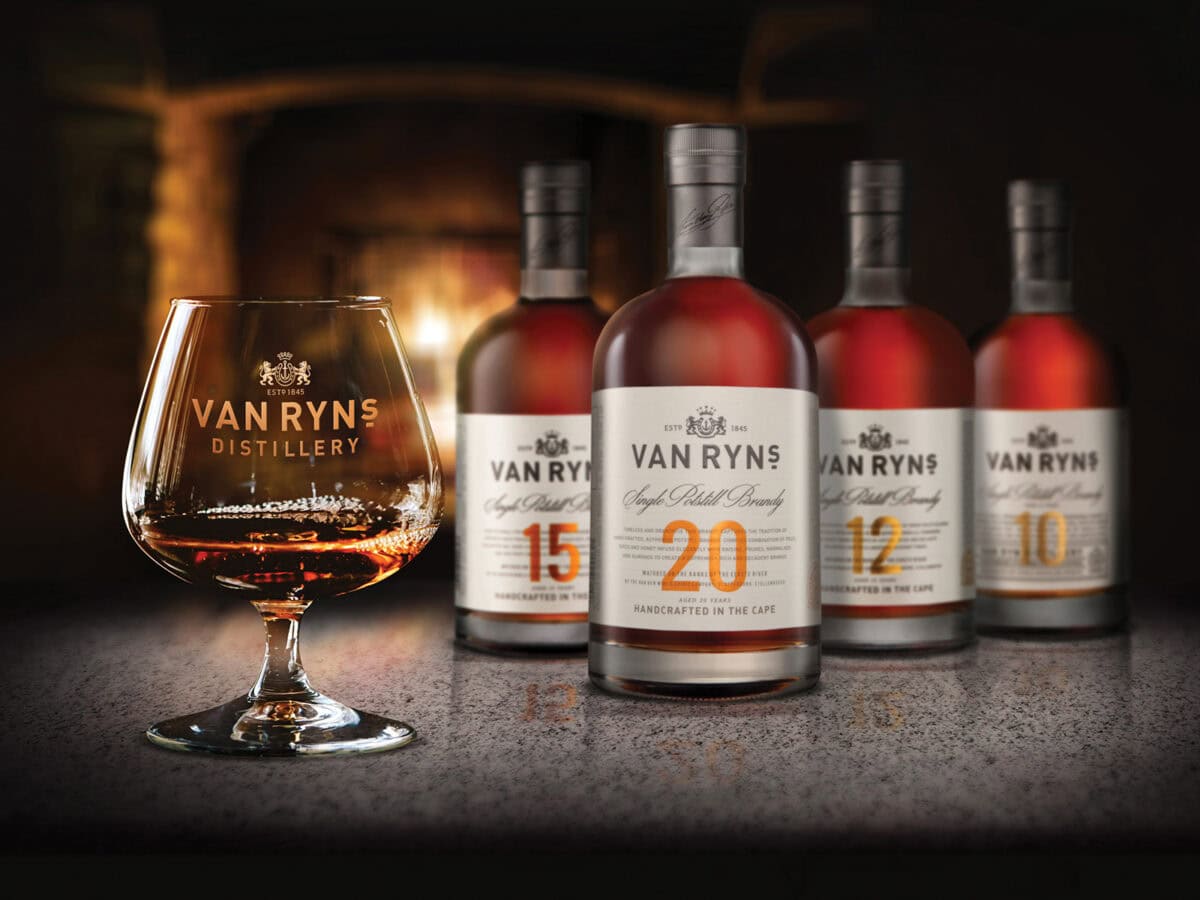
Van Ryn’s is the flagship brand of Distell, SA’s biggest distiller. Their Van Ryn’s 15-year-old pot-still brandy was named World’s Best Wine Brandy at this year’s World Brandy Awards for the second year in a row. In 2022, their 20-year-old won.
Pushed to pick a favourite child, Bester says she loves Van Ryn’s 12-year-old. ‘In summer when it’s 35 degrees outside, you can have it with two blocks of ice, and in winter it’s something quite different – you just heat the glass with your hand and get those warm citrus notes and some nuttiness. There’s a complexity that makes you want to go back and taste it again and again.’
Bester says her brandies are produced the same way cognac is made, only using different grape varietals. ‘These are brandies with beautiful floral, fruity characteristics from the grapes, and from the barrels, dark chocolate, nuttiness and vanilla flavours.’ The uniqueness for Cape brandies, she says, is the integration between the two flavour dimensions.

And yet, the designation ‘South African brandy’ still doesn’t roll off the tongue quite as luxuriously as ‘cognac’. That has much to do with perception. Despite a distilling legacy that’s almost as old as that of Cognac, we’re still received as young.
In the late 1930s, a tiny news item in The New York Times made mention of the arrival in America of a South African brandy for the first time. It was reported with all the wide-eyed surprise of a country bumpkin explaining a UFO sighting. For decades since, our brandies have represented insignificant real estate on international liquor shelves.
But Cape brandy makers are catching up to the luxury market’s potential. Our spirit innovators, perfectionists and upstarts are bringing a new sheen to our industry – both abroad and at home. The Cape Brandy Distillers Guild has helped birth a category of sipping brandy officially known as ‘Cape Brandy’ with a protected designation of origin. Some 23 distillers in the Western Cape are already recognised in this premium spirits division.
Among them are unconventional crusaders like Edmund Oettlé who has pioneered a kind of garagiste distillation operation using grapes grown under uncompromisingly hands-off conditions on his farm, Upland Organic Estate, in the hills above Wellington. You will not find any chemical fertilisers or sprays anywhere near his vines. He even made his own still, the only handmade one in the country that’s certified and still going strong after 27 years. It’s the country’s only organic certified distillery and makes South Africa’s only cask-strength (62% alcohol) brandy.

‘Nothing has been added, not even water!’ Oettlé says of what is some of the most expensive South African brandy on the market, its fruity notes topped by vanilla, lingering depth, and complexity of flavour with a dry finish, so reminiscent of great cognacs. His entry-level brandy is a 10-year-old XO made, unsurprisingly, in limited quantities.
To underscore the superlative status of this unique spirit, his Upland 24 Karat Directors Reserve XO Brandy has pure gold leaf flakes in it. Perhaps the perfect spirit to bring out if Victor Hugo were coming to dine.
Keith Bain