
Enamoured as we are in this day and age with open-plan living, it can pose challenges. Sometimes of the sort best solved by interior designers. So when a young professional couple working with Masterworx Architectural Design on the plans for their newbuild signed off the layout of their ‘forever home’, they had the savvy to enlist the help of interior designers Fyfe Boyce. The award-winning design duo first tackled the spatial planning – particularly of the open-plan entertainment area – and subsequently the finishes and furniture for the project.
Located near Ballito on KwaZulu-Natal’s North Coast, the newbuild takes the form of a modern twin-gabled coastal barn, with much of the exterior clad in black clip-lock metal sheeting. Oriented north-east, the ground floor open-plan entertainment area – which includes both indoor and outdoor kitchen, dining and living spaces – as well as the upstairs bedrooms benefit from a welcome amount of KwaZulu-Natal’s subtropical sunshine.
Top of mind for designers Bruce Fyfe and Kelsey Boyce was how to divide the lower level’s sizeable open floorplan into more intimate spaces, more suited to how the couple – and their two tweenagers – like to live. ‘Both architecturally and with respect to interior design, our clients insisted on a home suited to barefoot living,’ says Boyce. ‘Spaces in which it would be easy to entertain. Nothing precious, a home that would age well.’

Both designers were in agreement about carrying the colour black, so prevalent on the home’s exterior, inside, in the form of an accent. ‘As all the spaces were so open plan, it was important that we maintained a colour palette throughout, broken up slightly with black punctuation,’ explains Fyfe. ‘We considered black as an anchor, a way to stop the neutrals from being too overwhelming.’ Known in more recent years for residential projects in which they have fun with bold colour palettes and adventurous pattern play, in this instance Fyfe Boyce tended to the more sedate.
‘We played it quieter in this home, as our clients wanted a calm space. We reserved the colour and drama for smaller areas and kept the big players neutral. Where necessary, we could amp up the colour with art and accessories.’
The kitchen, much like the guest bathroom with its statement wallpaper, is monochromatic. Offsetting lacquered white cabinetry and lightly veined splashbacks is a monolithic black quartz island. It stands in strong contrast to the pale tones of the living room at the opposite end of the interior.
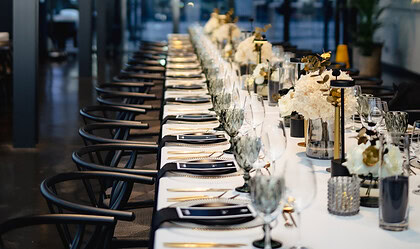
‘We opted for a dining table in smoked oak, as this tonal change bridges the kitchen’s finishes with the lounge’s timber tones. By doing so, the span feels intentional,’ explains Boyce. This isn’t the only decorating device the duo turned to in order to divide and conquer the open-plan space, while still cementing visual continuity.


‘While their gold colouring repeats the metallic accents we’ve used in the living room, the large cube pendants positioned above the dining table visually help drop the ceiling, creating a “room” without walls.’
To further divide the space, Fyfe Boyce introduced a slatted and curved wooden divider – a soft boundary, as they put it – between the dining and living areas. A monochromatic abstract artwork hung on the structure helps to create a division between the two rooms. At its base stands a custom-designed console (‘a favourite of ours in the home’), its pattern and rich texture serving as a focal point. It also links the textural palette indoors with that of the outdoor entertainment space.
Here, wood is used in a more expressive manner, like the timber-clad wall into which an outdoor kitchen was built, or in the form of a tree-root table base. ‘The slatted timber sunshade filters the heat and casts strips of light across the area, from which the family has views over the pool to the surrounding fields,’ says Fyfe of the terrace. ‘It’s a great place to relax.’ Because the same light porcelain flooring used indoors was extended outside to create a visually seamless flow, the designers employed decorating tricks other than changes in flooring to subdivide the space. Again, a cluster of pendant lamps above the dining table gives it intimacy, while a console abutting the back of a sofa helps create a barrier between the dining and living spaces. And again, much like indoors, black accents – the barstools’ metal frames, tabletop objet and stripes along rattan stools – intentionally interrupt an otherwise neutral expanse.

Delighted with the outcome, the family’s ‘forever home’ is at once both practical and approachably stylish. What at first might have felt like a potentially daunting open-plan entertainment space has been thoughtfully considered, and designed not just for easy enjoyment, but tailormade for barefoot living.