
On his days off, Vusi Ndlovu’s ultimate guilty pleasure is watching true crime, slacking off with fast-food takeaways.
‘It’s true, chefs don’t eat well,’ he says. In the next breath, however, he names some of his favourite restaurants, mostly places where there’s nary a bad meal to be found. Of the dishes he says he’ll always remember was one with mussels, smoked egg yolk and white carrots at Septime, a cult-status Parisian bistro with a Michelin star. ‘I’ll never forget it,’ Ndlovu says, ‘because, together, those ingredients aren’t supposed to make sense.’
Then again, figuring out the mysteries of how flavour works to magically alter the brain’s chemistry and connect with our emotions and memories is part of the job that Ndlovu signed up for.
Most of his waking life, when he’s not indulging his ‘normal guy’ proclivity for junk food and Netflix series, the Zimbabwe-born, Pretoriaraised chef is dreaming up ways of reimagining African cuisine, coming up with ideas to bravely and creatively embolden his menus to offer diners a meal they wouldn’t have had before.
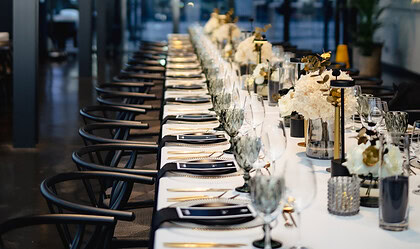
‘I feel that if you’re going to take the time and spend the money to eat out, you should have an experience unlike any other,’ he says. That is precisely what he endeavours to give diners at Edge, an indoor-outdoor rooftop space in a heritage building with well-worn wooden steps, raw brick walls and compelling views, in Cape Town’s city centre.


He established Edge with his wife and business partner Absie Pantshwa, gregarious and warm-hearted (and a generous hugger), who has a background in event management. She fell for Ndlovu after tasting his food at The Marabi Club in Maboneng, where he headed the kitchen before returning to Cape Town.
Together, they’re determined to alter perceptions South Africans have about restaurants serving food representing this continent. ‘Unfortunately, we Africans first need to succeed overseas. Only then can we come back and say, “Look, my food is delicious!”’
He cites Jan Hendrik van der Westhuizen as an example. ‘If our friend Jan didn’t have a restaurant in Nice and a Michelin star, he couldn’t have come home and served South African food to South African diners. But because he’s become a brand associated with success overseas, people figure he must be doing something right.’
Another part of the problem, Ndlovu believes, is the perception people have about food from this continent. He says that most of us tend to think of African cuisine in terms of clichés: usually it’s a very big plate of jollof rice with a large fish on top. Or a heap of pap accompanied by meat.
‘African cuisine definitely deserves a seat at the table,’ says Ndlovu. ‘Because we’ve got so many flavours, such incredible ingredients and such a diversity of dishes from this continent. And flavour profiles and spices and traditions that are crazy.’
Ndlovu is a maverick, doesn’t have a culinary school background and scoffs at the notion that he might have had some sort of rags-to-fame backstory. Food was not the centre of his world growing up. While his working mum brought a kind of efficiency to mealtimes, it was family holidays in Bulawayo, where he was born, that exposed him to the nuances of more traditional cooking. There, he’d get glimpses of the kind of celebratory meals and colourful dishes that are often associated with African food and colourful dishes that are often associated with African food culture. ‘We had all these ceremonies – funerals and weddings – when all the aunts would come with their best chakalaka, the creamiest pap, just the best-ever versions of typical dishes,’ he recalls.
Despite musing that he kind of landed in the restaurant business by accident, he in fact arrived where he is through tremendous hard work, tenacity and ceaselessly striving to innovate. Over the years, he quite literally stalked Peter Tempelhoff until he landed a place in one of his kitchens, and was later championed by celebrity chef David Higgs. Between emailing just about every famous chef on the planet asking for a chance to work in their restaurants and learn from them, to staying late after shifts to glean new knowledge, he has always been curious enough to discover more than what’s at the surface of his profession.

He’s also into competitive cooking, was placed seventh in the 2018 edition of the San Pellegrino Young Chef Academy Competition, and worked in prestigious restaurants in Europe. But it’s his instinct to innovate that’s unshakeable. He turned heads during a stint at the Mount Nelson when he created a mopane-worm soy sauce to season and marinate a beef dish. ‘I grew up with mopane worms and they’re a bit salty and very earthy. So, instead of salting the steak, which was from Jersey cows – quite rich, with a little bit of sweetness – we used our mopane soy. It was so tender and European diners were crazy about it. Everyone was convinced I’d used sous vide, but I’d simply sprayed it with mopane soy while cooking it over the fire – the flavour just sinks into the meat. We served it with charred lettuce to add a little bit of freshness and some burnt cream – it’s like crack!’
Although he may push the envelope with his ideas and inspiration, Ndlovu isn’t in the business of shocking or perplexing diners, or confronting them with unpalatable flavours. Rather, he makes food that takes you by surprise because it’s likely to alter your perception of what’s possible and show you how unfamiliar ingredients can be used to pull off something imaginative and unexpected.
Still, the finickiness of South Africa’s dining public isn’t lost on Ndlovu who says it takes a thick skin and a degree of stubbornness to have avoided caving to the temptation to just open another burger joint or taco bar, both money spinners.
Pantshwa says every night at Edge they have diners who start out slightly nervous because ‘they’re scared that they’re going to taste something so different’. She says it’s a bit heartbreaking that people are worried that the food might be ‘too African’. ‘It’s the funniest thing,’ she says. ‘Like they’ve forgotten they’re in Africa.’
What Vusi does is win you over one dish at a time with his tasting menu. It inevitably begins with ujeqe, a Zulu bun, steamed and fluffy and so delicious it’s a tough call whether to devour it as is or pull it apart and use it to soak up the intensely flavoursome beef jus that accompanies it. ‘And once they start tasting and experiencing, once they develop trust, they start ordering more and more,’ says Ndlovu. From the creamiest pap you’ve ever tasted to bokkom shavings with kingklip, and morogo-like amaranth alongside less-familiar cuts of meat, each dish mixes a sense of adventure with an attention to detail and process that ensures the flavours are elevated, refined – and definitely unique. ‘Just trust the process, be curious, and know that the last thing we’re trying to do is catch you off guard,’ Ndlovu says. What he will do, though, is transport you. ‘I try to take you somewhere. I want to stir nostalgia. And there must be an emotion.’


He’s aware that nostalgia and flavours work in profound and mysterious ways. He describes an incident at the Mount Nelson when an elderly Swedish woman cried while tucking into the bread course. ‘It was our ujeqe with beef sauce. I asked her if she was okay. And when she gathered herself, she told me that this traditional African dumpling reminded her of something that her mother used to bake.’
That resonated with Ndlovu because he still recalls the aroma of his own grandmother’s beef stew, which she prepared in a big pot and served with dumplings.
Humbling though such moments of universal connection are, it doesn’t stop at emotion and nostalgia. Ndlovu’s menus are admittedly mysterious. Even if you had his braaied broccoli last week, next month it might have been modified, whether because he’s discovered a new ingredient, or because the fire in the kitchen is burning hotter. Or because he’s grown bored with the broccoli and decided to modify, adapt, update and experiment. Variables are good for him, and keep him on his toes, which is where he thrives.
‘I spent time in France working at a hotel where everything was very precise, very military. Each plate was put on a scale, each dish executed in a certain way just so it could have that Michelin star: 12g of yuzu cream, six slices of langoustine, 16 oyster pearls… I thought, well, this is cute, this is pretty, and it’s delicious… But I also felt it was boring. There was no danger.
He says he likes a challenge, gets bored easily, abhors anything cookie cutter, and prefers an edge when he cooks. It’s why he enjoys doing pop-ups in new locations, or collabs with chefs in unfamiliar settings. All those variables add to the frisson, the modicum of danger that adds an X-factor to what he does.
‘I don’t want to do the same thing every day. The food has to evolve, it has to feel alive. That’s why we work with fire. There are so many variables. If the wood’s wet or the wind’s blowing a certain way, it can change the fire. So the way we cook also becomes a bit innovative. I love the challenge of unpredictability. It can drive me crazy and I lose my mind in the moment, but deep down there’s a thrill, and it’s fun, and that’s why I look forward to doing it again tomorrow.’
Ndlovu calls himself an ‘introverted extrovert’, something that filters into the way he cooks. ‘At Edge our food is very minimalistic’, he says. ‘Not that we’re shy, but we don’t try to make too much noise on the plate in order to make you notice us. Visually, your plate won’t be too loud, but when you eat what’s on it, we hope you’ll find it interesting.
by Keith Bain