
Recent figures coming from the number crunchers have confirmed what anyone living in popular travel destinations already knows: that Southern African tourism is back to pre-Covid-19 levels. Where exactly those travellers – specifically luxury travellers – are going is more interesting, with an uptick in remote regions such as the Karoo, the Eastern Cape, and isolated areas of Botswana and Namibia featuring prominently. Research suggests this is still a reaction to Covid-19, with renewed interest in destinations far from the madding crowd still as popular as they were in 2022. Namibia, of course, ticks all those boxes, and when masterminded through bespoke luxury operators Wilderness, the free radicals are taken care of – no tyre blowouts, no itinerary nightmares, no unfamiliar dirt roads. Wilderness Air and a fleet of cruisers see to all that. There aren’t many better ways of going to the ends of the earth without breaking a sweat.


Serra Cafema, on the banks of the Kunene River, trades in roaring rapids, fishing raptors, dune adventures and a sense of unrivalled calm.
Through the temporal membrane
Serra Cafema
Somewhere south of Wilderness’s northernmost camp, after you’ve landed at Doro Nawas Airstrip but before you reach the Rooiduin and Marienfluss mountains, it seems you slip through a cosmic curtain into a parallel universe, so removed is the landscape from anything familiar. Imagine a trek that hogsbacks red sand plateaus to the left, towering mountains to the right, then falls off – almost vertically – to a river course as green as the Kavango in April. It’s not the Kavango of course, it’s the Kunene River, a necklace of rapids welcoming you with a sound like the Atlantic some 80km away. This is rarest earth, far from any formal development, the land of the Himba and ancient lore. Every day here feels like a privilege.
Serra Cafema lodge overhangs the Kunene, on stilts mostly, built to withstand the annual floods. Raised walkways, hidden split-level lounge areas and suites that feature the river through the picture windows, as well as the 20-storey dunes and, of course, the Kunene River.
A typical stay at Cafema includes hiking or quad biking into the dunes, a visit to one of the Himba communities in the desert and time spent on the river. All of it trades in visceral contrasts; they’re everywhere – silk dunes, shattered rock, green edging, barren cliffs, protected inlets, sandblasted plateaus. It feels like nothing on earth and you will dream about it for a very long time afterwards.

Little Kulala, Wilderness’s property on the edge of Sossusvlei, features day beds under the stars and spa pools on porch suites.
Dunes, balloons, moons
Little Kulala
Little Kulala, one of 14 Wilderness properties in Namibia, is arguably its best-known. Within spitting distance of Dune Alley and the almighty Sossusvlei dunes, it has much to recommend it: vistas across the Namib-Naukluft desert plains, drives onto mountain tops, suites with outside and inside beds, plunge pools, a wraparound outside dining area and next-level wine cellar. But, primarily, it serves as the launch pad for those exceptional dunes. Up early, out in the cruisers by six, it’s a short drive to the dedicated Wilderness gate close to the Namib-Naukluft National Park entrance. That’s important because getting to Sossusvlei early means cooler temperatures for climbing Big Daddy, that behemoth of a dune, and fewer tourists, most of whom arrive mid-morning. And if you’re hell-bent on avoiding all tourists, there’s an even more bespoke way of seeing the dunes; by air. Or balloon, more accurately. Weather dependant, Namib Sky Balloon Safaris gets going early, all the better for Martian sunrise flights over the archaic landscape as a full moon gives way to a vast, clear sky. It’s not cheap, but, like the small boats down the Lemaire Channel off Antarctica, it’ll stay with you forever.

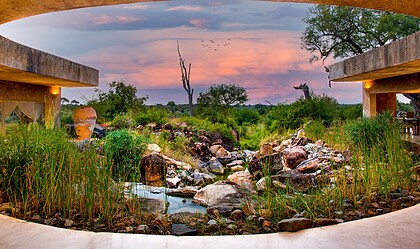
Rhino Desert Camp, situated in a remote corner of Damaraland, specialises in walking safaris to see the rare, desert-adapted black rhinos. Suites are bespoke tented units that celebrate the stories of the area through artwork above the beds.
Around the horn
Desert Rhino Camp
If Little Kulala is Wilderness’s best-known camp in Namibia, Desert Rhino Camp is its most ambitious. It’s here, in the far-off Kunene Region, that an impossibly luxurious tented oasis exists largely to support one of the region’s boldest conservancy projects. Rare desert black rhino are protected by three conservancies totalling 10 000 square kilometres, Torra, Sesfontein and Anabeb, and the Wilderness property sits bang in the middle. Rhino ‘walks’ start early, a dedicated team
locating, alerting and guiding guests in a safari vehicle to the splendid creatures. It’s all hyper-regulated (how long you can be there, how close you can get) but fully worth it, as much for the archaic landscape as the horned omnivores. And part of that glowing red rock landscape are the welwitschias, earth’s oldest living conifers, lazy dual flops extending across the landscape in messy swirls. The plants, some of which are 2 000 years old, have been growing here for more than 86 million years.
Desert Rhino Camp itself has been reimagined, an ultra-luxurious design triumph that’s both handsome and practical. Migs+Drew (M+D) architects did all the hard work, stretching fabric roofs over locally sourced stone, hunkering the suites down against the summer heat. Glass sliding walls transform interiors into exteriors and the raised, outside day room is a genius idea.
Interiors too are dramatic and luxurious, designer Cate Simpson’s deft touch evident in the materials and artwork, most notably the old collection of ’80s slides from the Save The Rhino Trust, retouched, transferred onto fabric and turned into headboards.
Wilderness
Formerly Wilderness Safaris, the luxury safari experts have recently rebranded to underline their emphasis as a purveyor of outright luxury in the wildest of places. They offer access to more than 60 camps across Africa, their latest ventures being the new nine-tented Mokete Camp in the Mababe Depression south of Chobe, Botswana, as well as Bisate Reserve in the Volcanoes National Park, Rwanda. For itineraries and destinations, visit wildernessdestinations.com.
Peter Frost