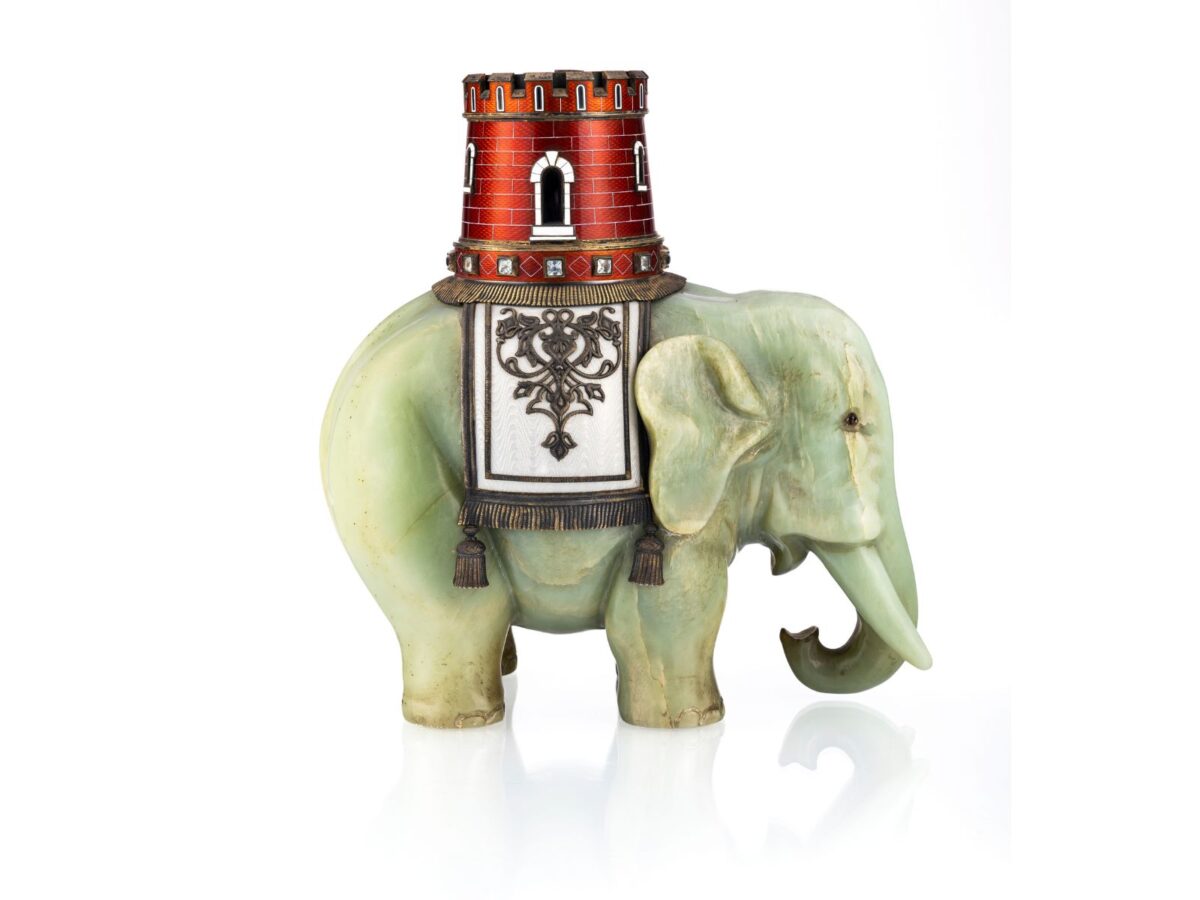
A previously undocumented Fabergé creation is set to appear on the art market for the first time, more than 120 years after it was made. The 28.5cm hardstone elephant, commissioned by the Russian Imperial Family in 1900, was recently discovered in a Geneva apartment belonging to the heirs of the Reuter and Gordon Bennett families.
Named ‘Gordie’ by the Carl Fabergé Foundation, the piece is believed to have been presented to American publisher James Gordon Bennett Jr. by Grand Duke Alexei Alexandrovich, brother of Tsar Alexander III. It will be offered at Piguet‘s Geneva auction on 9 December, with an estimate of CHF 200,000–300,000.
The discovery was made by Christina Robinson, Head of Russian Works of Art at Piguet, during a visit to the family’s apartment. The quality of the carving, the stone used and the translucent red enamel prompted further investigation. Research undertaken with the support of the Carl Fabergé Foundation subsequently confirmed its attribution to Fabergé.
A rare example of Fabergé craftsmanship
Carved from bowenite, a hardstone known for its toughness and the technical skill required to work it, Gordie measures 28.5cm in height, making it the largest Fabergé elephant currently known. Before its discovery, only two other examples had been recorded: one carved from bowenite and another from nephrite.
The elephant also has a particular connection to the Russian Imperial Family. Empress Maria Feodorovna, wife of Tsar Alexander III and mother of Nicholas II, was born Princess Dagmar of Denmark. Her father, King Christian IX, ruled a kingdom whose highest order of chivalry was the Order of the Elephant, represented by the animal depicted in the sculpture.
The connection to James Gordon Bennett Jr.
The identity of the likely recipient adds another dimension to the object’s history. James Gordon Bennett Jr. (1841–1918), owner of the New York Herald, was a prominent figure in international publishing and society during the Belle Époque. He was also a keen supporter of sport, sailing and technological innovation, establishing the Gordon Bennett Cups, which contributed to the development of motoring and aviation.
Bennett maintained close connections with members of the Russian Imperial Family, particularly Grand Duke Alexei. Their relationship dates back to 1871, when Alexei visited the United States on an official tour. Keen to secure an exclusive story, Bennett dispatched a vessel to meet the Russian frigate Svetlana, allowing the New York Herald to report the Grand Duke’s arrival ahead of its competitors. He later hosted Alexei at a banquet at Delmonico’s restaurant in New York.
Their association continued over the following decades. In 1881, after the ill-fated Arctic expedition of the Jeannette, which Bennett had financed, Tsar Alexander III personally ordered assistance to be sent to the survivors. Bennett’s yacht, Lysistrata, was eventually sold to the Russian Imperial Navy in 1916 and converted into a military vessel.
Completed in 1901, Lysistrata was characteristic of Bennett’s extravagant tastes. The yacht featured a Turkish bath and sculptures of owls, his favourite animal, with electrically illuminated eyes. It was also reportedly equipped with a motor car for journeys ashore and even housed a cow to supply fresh milk.
It was within these established connections between Bennett and the Russian Imperial Court that the Fabergé elephant is believed to have been presented.
From private collection to auction
Gordie remained within the Reuter–Gordon Bennett family for more than 120 years and had never previously appeared on the art market. Its discovery provides new insight into Fabergé’s imperial commissions and the relationships between the Russian court and prominent international figures of the period.
The elephant will be exhibited at Geneva’s Hôtel d’Angleterre from 6 to 8 November, before moving to Piguet’s exhibition rooms from 3 to 6 December.
The auction is scheduled for Wednesday, 9 December 2026, at 6pm CET, with an estimate of CHF 200,000–300,000. The online catalogue will be available from 26 November.