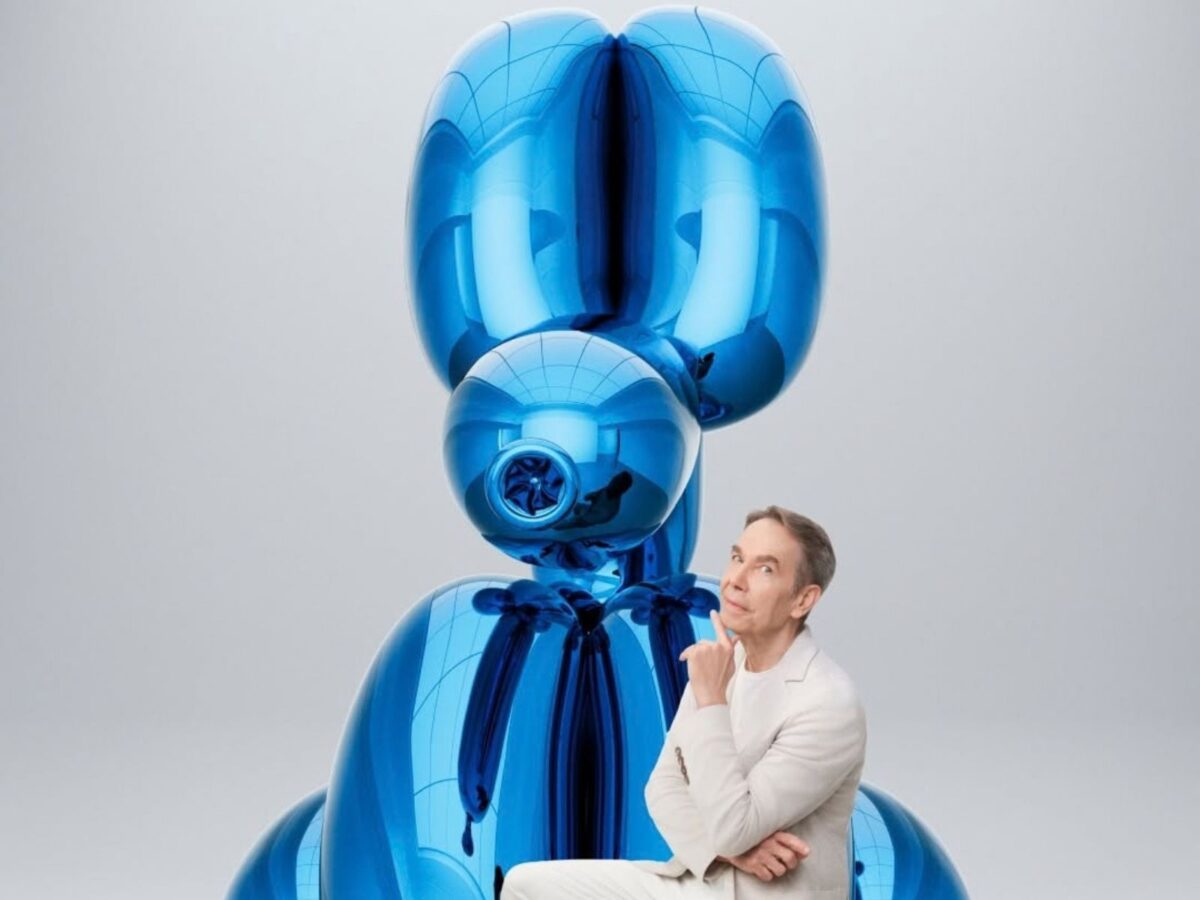
What happens when one of contemporary art’s most recognisable forms is translated into the language of watchmaking? In the case of Jeff Koons and Hublot, the answer is something that sits somewhere between sculpture, design and horology.
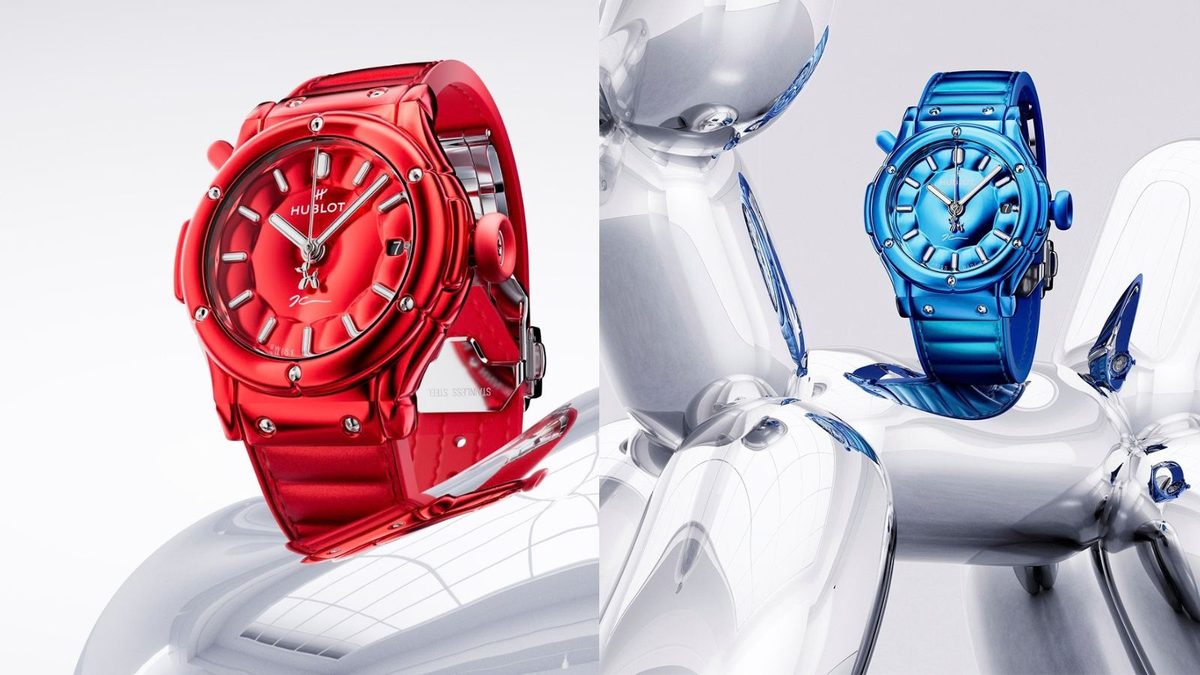
The Classic Fusion Balloon Dog by Jeff Koons takes the artist’s celebrated Balloon Dog and reimagines it as a 42mm timepiece. Limited to 200 pieces in each of three editions, mirror-polished stainless steel, red anodised aluminium and blue anodised aluminium, it is less a watch inspired by a work of art than an attempt to make the visual language of that work wearable.
Koons’ Balloon Dog, created between 1994 and 2000 as part of his Celebration series, is built around a simple contradiction. The balloon animal is familiar, playful and fleeting; Koons renders it in monumental, mirror-polished form, turning something temporary into something seemingly permanent. It is an idea that has become central to his practice: taking the everyday and transforming it through scale, material and meticulous execution.
The new Classic Fusion picks up on that same tension
Rather than simply placing a reference to the sculpture on an existing watch, the collaboration reworks the architecture of the Classic Fusion itself. Its traditionally streamlined profile has been reshaped with rounded, inflated forms, convex surfaces and domed elements designed to create the impression that the watch has been filled with air.
The effect is particularly striking in the details. The sapphire crystal is domed, the titanium screw heads have been softened into rounded forms and the dial takes on a distinctly padded appearance. Even the strap has been given a smooth, almost inflated quality. A balloon-inspired crown, a decorative tail at 10:30 and a Balloon Dog-shaped counterweight on the seconds hand bring the reference to Koons’ sculpture into the smallest elements of the design.
It is a playful object, but creating that playfulness was anything but simple
Much of the work took place beneath the surface. Components had to be redesigned and milled using five-axis CNC machining before being finished by hand, allowing the watch to maintain its sculptural volume while retaining the precision expected of a mechanical timepiece. Inside, a manufacture automatic movement is paired with a custom tungsten oscillating weight whose rounded form echoes the inflated geometry of the case.
That meeting of art and engineering is where the collaboration becomes particularly interesting. Koons’ work often looks deceptively straightforward: a balloon animal, a rabbit, a puppy. But the apparent simplicity is the result of extraordinary control over form, surface and material. Here, Hublot has approached the watch in much the same way, using the technical possibilities of horology to recreate something that is deliberately light-hearted in appearance.
There is also a natural connection between Koons’ fascination with transformation and Hublot’s own history of experimentation. Since its founding in 1980, the Swiss watchmaker has built much of its identity around unexpected combinations of materials and forms, from its early gold-and-rubber watches to the Big Bang and the evolution of the Classic Fusion.
The collaboration pushes that philosophy into more sculptural territory
Aluminium was chosen for the red and blue editions in part for its ability to reproduce the saturated colours associated with Koons’ work, while the stainless-steel version takes a more restrained approach with a mirror-polished finish. Across all three, reflection is central: the surfaces catch light in a way that makes the watch feel closer to a miniature sculpture than a conventional timepiece.
Even the packaging continues the idea. Each watch is accompanied by a chromed Balloon Dog, colour-matched to its corresponding edition, extending the relationship between the wristwatch and the artwork beyond the case itself.
For Koons, the appeal of Balloon Dog has always gone beyond its instantly recognisable silhouette. Beneath the polished surface is an exploration of memory, shared cultural symbols and the transformation of ordinary objects into something with a sense of permanence. The new collaboration carries that idea into an entirely different medium, creating a piece of wearable art.