At Cartier, the boundary between watchmaking and jewellery has long been a source of creative possibility. The Maison’s latest jewellery watches continue this tradition through three collections: Grain de Café, Tank and Myst de Cartier. Each offers a distinct interpretation of the relationship between form, material and movement, drawing on a design legacy shaped by Louis Cartier and Jeanne Toussaint.
The result is a study in contrasts. Architectural lines meet organic forms, while diamonds, coloured stones and sculptural gold details transform the traditional wristwatch into something closer to wearable art.
Grain de Café: An unconventional motif
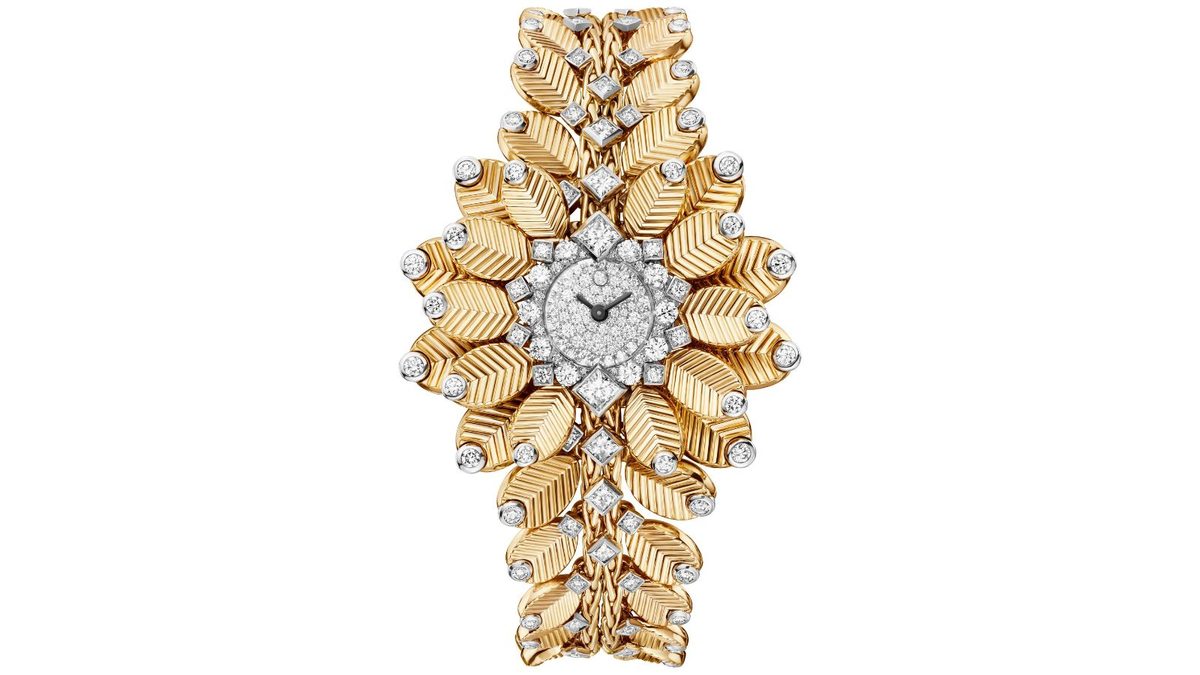
First introduced in 1938 by Jeanne Toussaint, Cartier’s Creative Director from 1933 to 1970, the coffee bean motif has occupied a distinctive place in the Maison’s design history. Its latest interpretation marks the first wristwatch in the Grain de Café collection, revisiting a motif that has appeared in Cartier creations across the decades, including a brooch watch in 1947.
Crafted in yellow and white gold, the watch is defined by a textured, sculptural arrangement of moving coffee beans that encircle the dial. Brilliant-cut and princess-cut diamonds introduce contrasting facets, while the snow-set diamond dial adds another layer of texture.
Rather than treating ornament as an addition to the watch, Grain de Café makes it the defining feature. The result is an expressive design that draws on Cartier’s botanical influences without sacrificing the technical considerations of a wristwatch.
Tank: An architectural expression
Few watch designs are as immediately recognisable as the Cartier Tank. Its rectangular case and parallel brancards have made it a defining example of the Maison’s approach to geometry, proportion and enduring design.
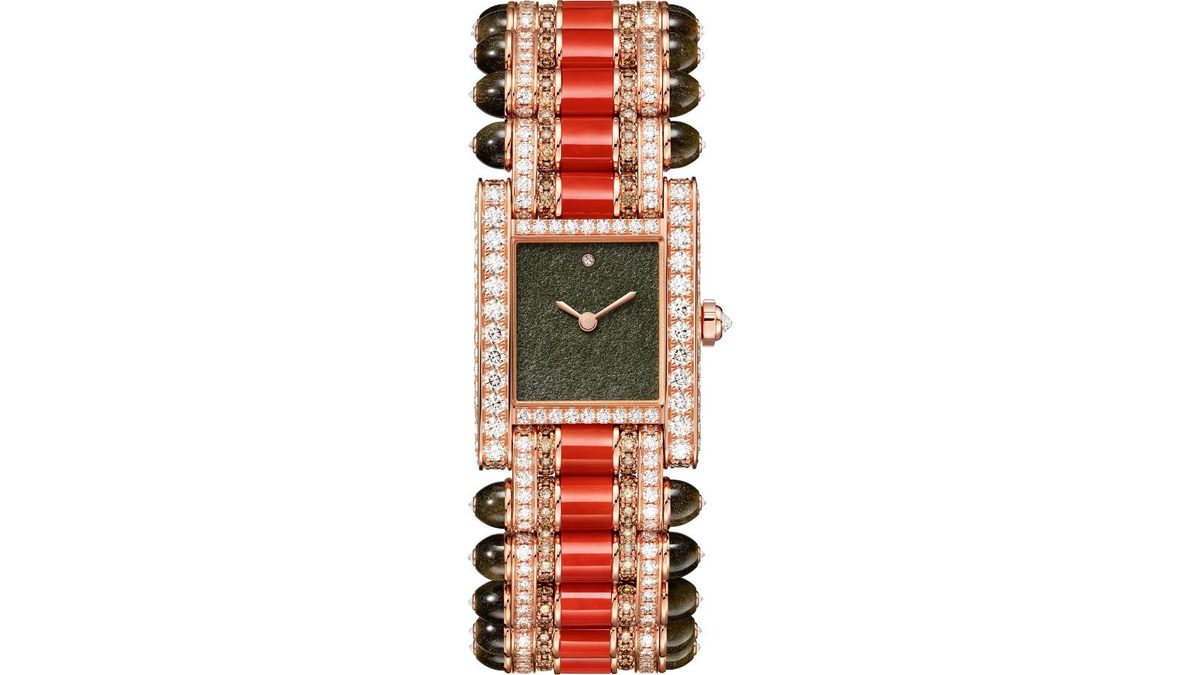
The jewellery watch interpretation builds on this established silhouette, introducing materials and details that reference the Art Deco period. Available in white and rose gold, the designs pair diamond-set elements with contrasting stones: onyx in the white gold version and coral and golden obsidian in the rose gold model.
The flexible bracelet is composed of articulated cylinders connected by diamond-set links, with a studded cabochon and an inverted pavilion diamond completing the construction. Beyond their decorative role, these details create a sense of movement and dimension, bringing a softer, more tactile quality to the Tank’s characteristically architectural form.
Myst de Cartier: A sculptural study in form
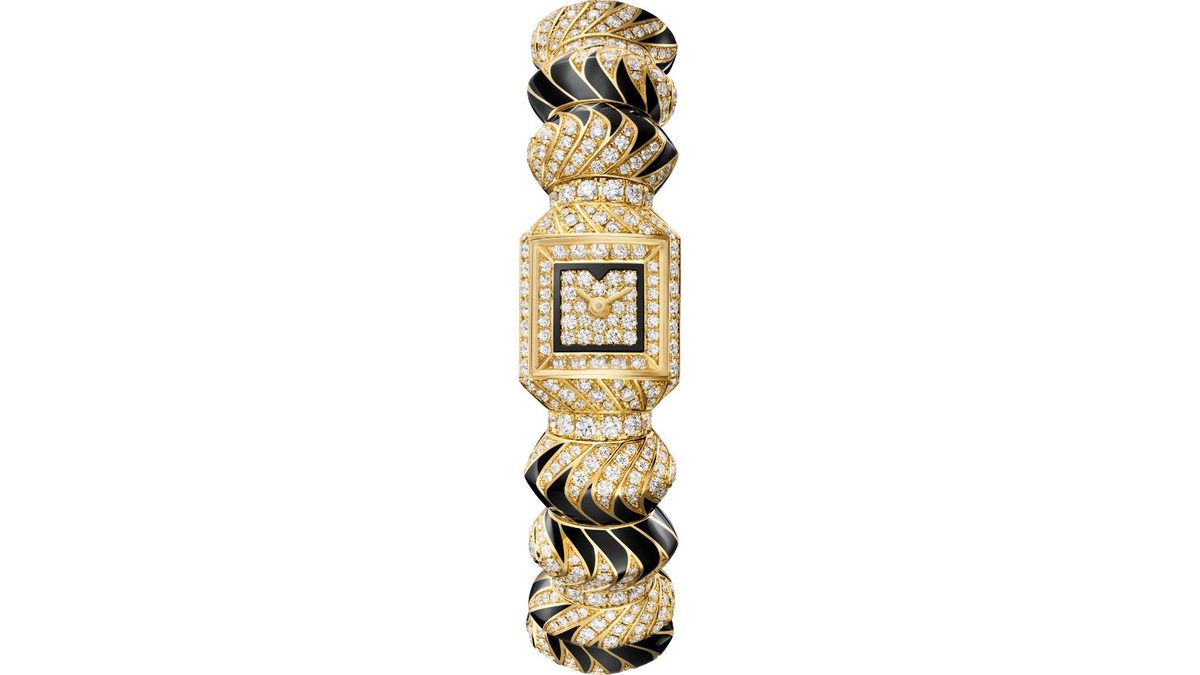
With Myst de Cartier, the Maison takes a more organic approach to the jewellery watch. Conceived to evoke a trompe-l’œil bracelet, the design comprises sculptural sections strung together like pearls on an elasticated bracelet. The absence of a clasp allows the piece to retain the fluidity of a continuous form.
A bead-setting technique brings depth and perspective to the bracelet, using stones of different sizes to create volume. In the yellow gold version, black lacquer lines are painted by hand, one by one, by an artisan at Cartier’s Maison des Métiers d’Art in La Chaux-de-Fonds, Switzerland. A monochromatic white gold version, set entirely with diamonds, offers an alternative interpretation of the same design.
The latter requires 112 hours of setting work, underscoring the precision involved in creating a piece in which the setting is integral to its overall form.
A dialogue between two crafts
Across all three collections, the emphasis extends beyond the materials themselves. Each watch reflects a dialogue between the jeweller’s creative vision and the watchmaker’s technical expertise, with neither discipline taking precedence over the other.
That approach also speaks to the influence of Jeanne Toussaint, whose designs embraced volume, organic shapes and a sense of movement. Her legacy remains evident in the expressive forms of Grain de Café and Myst de Cartier, while the Tank jewellery watch revisits the geometric language that has long defined the Maison.
Together, the three collections demonstrate how Cartier continues to explore the jewellery watch as a form of design in its own right. Here, timekeeping provides the foundation for a broader creative expression, one in which craftsmanship, material and silhouette are as central as the function on the wrist.